BY JULIET NONYE
Abuja
A senior United States lawmaker has denounced what he describes as a campaign of “transnational repression” orchestrated by Nigerian authorities and affiliated actors to intimidate and silence critics who have spoken out about religious persecution in the country.
Rep. Chris Smith (R-NJ), Chair of the House Foreign Affairs Subcommittee on Africa, recently issued a pointed statement concerning the aftermath of a March 12 congressional hearing on religious freedom violations in Nigeria. The hearing, which featured testimony from Catholic Bishop Wilfred Anagbe and international human rights lawyer Emmanuel Ogebe, drew renewed focus to Nigeria’s treatment of religious minorities, particularly Christians in the Middle Belt.
“They Are Being Targeted for Telling the Truth”
At the center of Smith’s condemnation are the retaliatory threats and attacks allegedly directed at Bishop Anagbe and Ogebe.
“I am appalled by reports that Bishop Wilfred Anagbe and Father Remigius Ihyula are facing threats—allegedly from Nigerian government sources and affiliated organizations—because of the Bishop’s testimony before Congress detailing violence in Nigeria’s Benue State,” said Smith in his April 10 statement.
Bishop Anagbe’s testimony painted a grim picture of mass atrocities, including widespread killings by Fulani herdsmen, the displacement of Christian farming communities, and the occupation of ancestral lands. The Nigerian government dismissed his testimony as “misinformation,” a characterization Smith rejected outright.
“These alarming acts of intimidation are not isolated,” Smith added. “They reflect a troubling pattern of retaliation linked to testimony before Congress on religious freedom abuses in Nigeria.”
Ogebe’s Long Fight—and Rising Risks
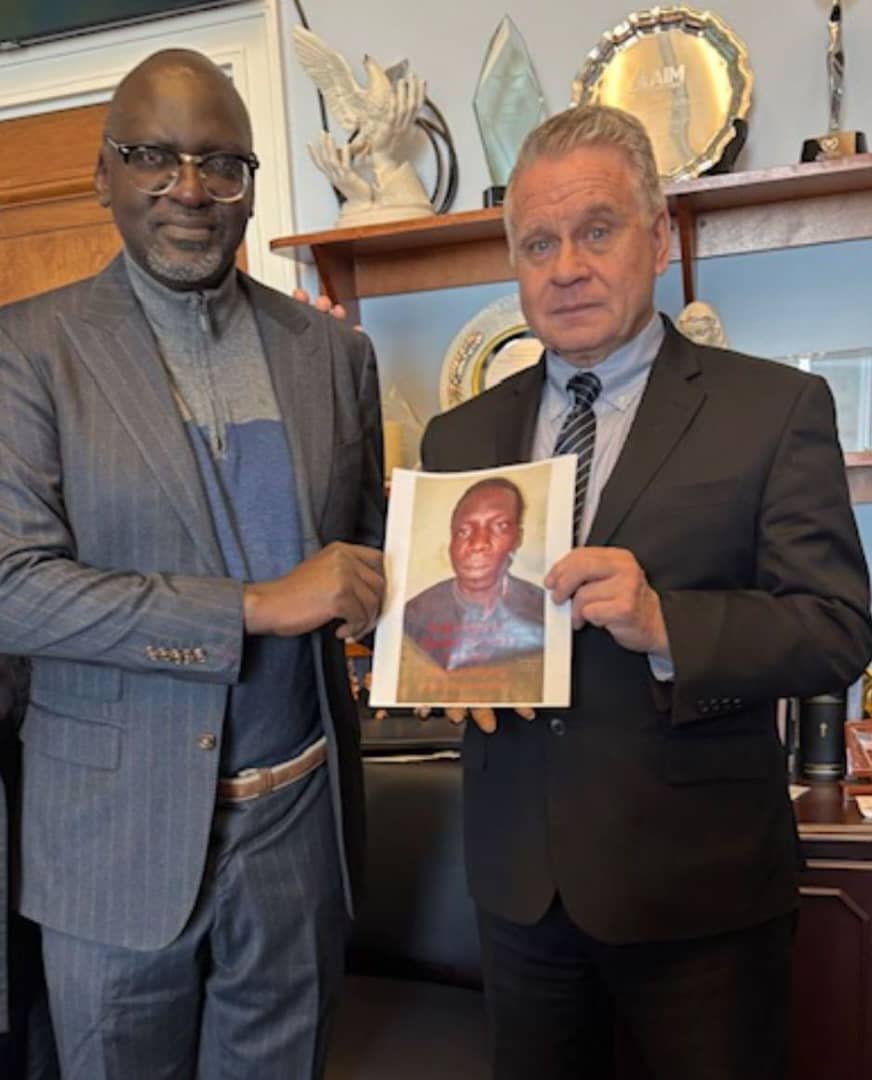
Smith also spoke directly to the ordeal of Emmanuel Ogebe, who has been engaged in a years-long battle to defend persecuted Christians.
“Mr. Ogebe was forced to sue to protect his constitutional rights,” Smith said. “Others remain in hiding. In the worst cases, they become martyrs. This must end.”
Ogebe, a Nigerian-American attorney, gained attention for his congressional testimonies on Boko Haram atrocities that led to the group’s designation as a “Foreign Terrorist Organization”. Since then, he has been targeted by attempts to revoke his passport, discredit his reputation, and pressure his associates. Most recently, he has taken up the case of Sunday Jackson, a Christian farmer sentenced to death for killing a Fulani attacker in what he claims was self-defense. Jackson’s death sentence, upheld by Nigeria’s Supreme Court in March 2025, has sparked national and international outrage.
Ogebe’s legal efforts to stop the execution have made him a visible—and controversial—figure. “Standing up for Sunday Jackson has earned Ogebe new enemies in high places,” said a colleague familiar with the case. “But he remains undeterred.”
“Foreign Thuggery Has No Place in America”
Smith warned that such efforts to intimidate and harass witnesses on American soil echo tactics used by authoritarian states like China and Russia.
“This thuggery not only threatens fundamental human rights, but it also violates U.S. criminal law and undermines a core congressional oversight function,” Smith said. “The United States cannot allow foreign actors to intimidate or harass individuals within our borders for exercising their basic rights—particularly those who are assisting Congress by providing testimony.”
He has called for aggressive interagency action involving the Department of State and Department of Justice, and has introduced H.R. 3654, the Transnational Repression Policy Act, which would impose sanctions on foreign officials who target U.S.-based dissidents or witnesses.
Religious Freedom in Freefall
Nigeria has faced mounting criticism over its handling of religious violence. According to Open Doors, Nigeria accounted for over 3,000 of the world’s 4,476 Christian deaths in 2024 alone. The Middle Belt region, especially Benue State, has become an epicenter of bloodshed between Fulani militias and predominantly Christian farming communities.
Bishop Anagbe described the situation starkly during his testimony: “They want me silent, but the world must know the truth.”
Catholic leaders in Nigeria, including the Catholic Diocesan Priests’ Association, have rallied behind Anagbe, denouncing what they call “state-enabled intimidation.” Religious freedom advocates say the bishop’s case is part of a broader effort to stifle dissent and whitewash systemic violence.
A Push for Accountability
Smith continues to push for Nigeria’s re-designation as a Country of Particular Concern (CPC) under the U.S. International Religious Freedom Act. The CPC status, which allows for sanctions and diplomatic penalties, was lifted in 2021—an omission Smith and rights groups say sent the wrong signal.
“The CPC designation is not symbolic,” said Smith. “It is a clear message that the United States will not ignore systemic, state-enabled persecution.”
As international pressure mounts, the cases of Bishop Anagbe and Emmanuel Ogebe have become emblematic of a wider crisis: the struggle to speak truth to power in the face of mounting danger.