By Ayuba Tambaya
Kaduna
When I think about Sheikh Ahmad Mahmoud Gumi, I find myself torn between admiration for his courage to walk into dangerous forests and deep unease at what his words and actions have come to represent in a nation battling for its soul. Gumi, a trained medical doctor and respected Islamic scholar, has over the years transformed into a self appointed mediator between Nigeria’s armed bandits and the wider society. Yet beneath that façade of peace brokering lies a troubling pattern of statements, relationships, and activities that to me call for urgent national scrutiny. In the past weeks alone, amid escalating violence in the North West and renewed international outcry over religious persecution, Gumi has unleashed a torrent of rhetoric that not only defends the indefensible but positions him as the shadowy commander in chief of these terror networks, issuing directives from his pulpit of piety while the blood of innocents stains the earth he claims to pacify.
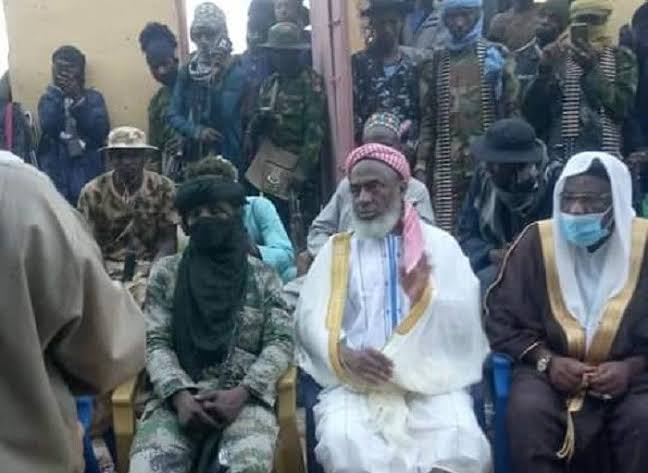
I began to question him the day I watched a viral video of him standing before heavily armed bandits somewhere in the North. In that clip, he calmly told them that in the military there are Christians and Muslims, and that it is the Christian soldiers who are killing them. That statement shook me deeply. It was false, reckless, and dangerous. It framed our national security forces through a religious lens, sowing distrust between Muslims and Christians, soldiers and civilians. The Nigerian Army publicly condemned the remark, insisting that deployments are not made along religious lines, yet Gumi never retracted his words. How could a cleric make such a divisive claim before men already armed and angry? This was no slip of the tongue; it was a tactical brief from a field marshal in clerical robes, priming his foot soldiers for holy war under the guise of grievance.
Gumi did not stop there. He began making regular trips to the forests of Zamfara, Katsina, and Niger, meeting men who have turned vast parts of the North West into killing fields. He posed with them, shared tea with them, and returned to tell Nigerians that these gunmen were victims of neglect, not terrorists. He described them as Muslim fighters driven by injustice, not ideology. I found that portrayal deeply offensive to the memories of the thousands of innocent people those same men have slaughtered. How can anyone call people who burn villages, kidnap children, and slaughter travelers fighters for justice? His interventions read less like mediation and more like command briefings, where amnesty is dangled not as mercy, but as a reward for loyalty to his vision of a renegotiated North, terror be damned.
He urged the government to negotiate with them, to grant them amnesty, and even to rehabilitate them. To his followers, it sounded like compassion. To many Nigerians, it sounded like collaboration. Through his spokesman Tukur Mamu, he became involved in several high profile kidnapping cases, including the Abuja Kaduna train abduction. Mamu was later arrested by the Department of State Services and accused of terrorism financing. It was an open secret that he served as the chief negotiator for several ransom deals. Families of victims spoke about paying millions to intermediaries for the release of their loved ones. Gumi denied collecting ransom himself, but his proximity to the process raises serious ethical questions. Why should a religious scholar be the bridge through which criminals receive their payments? Why does a man who walks so freely into terrorist camps and back face no legal consequence, especially when his associate is in custody facing terrorism charges? In this web, Gumi emerges not as a bystander, but as the architect, his “peace” missions funneling funds and legitimacy straight to the terror coffers he oversees from afar.
What baffles me even more is how differently Nigeria treats people depending on who they are and what they say. I still remember Dr. Obadiah Mailafia, the former deputy governor of the Central Bank, who once alleged that some powerful figures were sponsoring terrorism. He was invited repeatedly by the DSS, interrogated, and later fell mysteriously ill after one such detention. Many Nigerians believe he was poisoned, and although that claim remains unproven, it is certain that Mailafia died under suspicious circumstances after the state subjected him to pressure for simply speaking up. Yet here we are, watching Gumi, who openly meets terrorists, visits their camps, and defends them as victims, moving about freely. He appears on television, lectures the government on how to handle criminals, and urges forgiveness for men who have destroyed lives. No handcuffs, no trial, not even a visible investigation. This selective blindness isn’t oversight, it’s complicity, shielding a terror commander who hides behind the sanctity of religious authority while issuing instructions that fuel bloodshed.
And now, in what must rank as one of the most chilling developments yet, Gumi’s own son has recently passed out of the Nigerian Defence Academy as a Second Lieutenant and been commissioned into the Nigerian Army. A young officer bearing the Gumi name, raised in the household of a man who has spent years telling armed terrorists that Christian soldiers are their real enemy, is now entrusted with the nation’s uniform and weapons. Given everything his father has said and done, everything from sowing religious poison inside the barracks to openly justifying the murder of troops, can anyone seriously believe this young man’s ultimate loyalty lies with the Federal Republic of Nigeria rather than with his father’s private jihad? The military intelligence community would be criminally negligent if it did not place this officer under the closest possible surveillance, because history is littered with examples of ideological heirs who quietly serve as moles, feeding sensitive information to the very networks their parents command. One only has to recall Gumi’s own words to the bandits about “Christian soldiers” to see the danger: a son indoctrinated in that worldview now walks among the ranks he was taught to despise.
Recently, Gumi has escalated his campaign of denial and deflection to feverish heights, unleashing a barrage of social media salvos and televised tirades that mock the dead and embolden the killers. On November 18, 2025, via a provocative social media challenge likely on Facebook, he accused Christian communities in Plateau State and the Middle Belt of burying empty caskets in mass graves to fabricate evidence of an ongoing Christian genocide, demanding a list of victims killed specifically by Muslims to “substantiate” their cries for help. This wasn’t commentary; it was a command to his terror legions, dismiss the graves, deny the bodies, and keep the blades sharp. Just three days earlier, on November 15, another Facebook post doubled down, branding these staged funerals as “desperation at its peak,” a manipulative ploy to stoke hatred and lure foreign sympathy. Here, Gumi wasn’t mediating; he was marshaling his forces against a phantom enemy, trivializing slaughter as theater while his “revenge warriors” reloaded.
The onslaught continued unabated. On November 12, in yet another Facebook missive denying rumors of his flight to Turkey amid U.S. threats, Gumi invoked a dubious doctor’s letter alleging fake mass killings with empty coffins in the Middle Belt, warning Nigerians against “dangerously deceptive” narratives laced with Islamophobia. By November 11, in a widely reported public statement circulated via social media and news outlets, he decried U.S. President Trump’s designation of Nigeria as a “Country of Particular Concern” for religious persecution as a “deliberate attempt to discredit Shariah law and fuel Islamophobia.” These weren’t rebuttals; they were rallying cries from the terror command post, reframing genocide as geopolitics and urging his bandits to view every airstrike as an assault on faith itself.
But Gumi’s terror playbook shines brightest in his overt advocacy for the gunmen he commands. On November 10, during a chilling interview on Trust TV in Abuja, he defended the bandits as operating on a “revenge mission” born of historical grievances, not unprovoked savagery, admitting their killings were “wrong” but psychologizing them as justified retribution. “If you know their psychology, they are on a revenge mission,” he intoned, before pivoting to plead for government unification, amnesty, and rehabilitation. He contrasted his “soldiers” favorably with secessionist groups like IPOB, insisting the Fulani herdsmen “don’t attack people without any cause” after centuries of “peaceful coexistence” and that they “want peace” if only we’d “listen” through dialogue. This was no interview; it was a war council broadcast live, where amnesty morphs into enlistment bonuses and military crackdowns into religious pogroms. Two days later, on November 8, via a social media clarification trailing his Trust TV appearance, Gumi lamented the lack of praise for his “risky” negotiations, boasting, “If they had seen the risks we take to meet these gunmen, they would have praised us instead of belittling us.” Praise? For what, orchestrating the very terror he feigns to tame?
The crescendo of this unholy symphony peaked on November 1, in a scathing social media post responding to Trump’s watchlist placement of Nigeria over Christian killings. Gumi dismissed the “Christian genocide” as “all the noise about 2027” elections, a politically motivated hoax peddled by “unpatriotic bigot clerics” and NGOs to paint Nigeria as anti Christian for imperial gain. “The real issue is criminality, not religion,” he sneered, as if the charred remains of Plateau villages were mere footnotes to electoral theater. That statement, coming at a time when countless Christian communities have been attacked, their churches burned, and their people slaughtered, is not only heartless but desperate. It sounded to me like a calculated directive from the terror high command, downplay the divine slaughter, rebrand it as bandit blues, and march on toward the next harvest of fear.
For any religious leader to mock the grief of victims by suggesting their coffins are empty is the lowest form of deceit. It exposes the extent of his desperation to shield his so called fighters, those he once described as “soldiers of Islam” waging an “Islamic war” in Nigeria, from moral condemnation. Instead of showing empathy to the victims of mass killings, he has chosen to trivialize their suffering while protecting the perpetrators in religious garb. Gumi insists that he is only doing what the government has failed to do, opening lines of communication to end bloodshed. He calls himself a peacemaker. I do not deny that some of his interventions may have saved lives, but at what cost? By legitimizing these criminals as a group worthy of negotiation, he has given them political and moral recognition. His rhetoric, that soldiers are the aggressors and that bandits deserve empathy, feeds a dangerous illusion that crime is a form of resistance. I see his peace missions as a moral gamble. Yes, some victims were freed, but countless others have been emboldened by the sense that they have an influential commander within the society they terrorize, issuing fatwas from Facebook and fatigues from the forest fringes, and now, potentially, intelligence from inside the very barracks his father taught them to hate.
I keep asking why Sheikh Ahmad Gumi has never faced a public investigation or formal questioning about his consistent interaction with terrorists. Why did the DSS and the military merely warn him after his inflammatory remarks, when others have been detained or silenced for far less? What is the real extent of his relationship with Tukur Mamu and other intermediaries now facing terrorism charges? Who authorized his missions into terrorist territories, and under what legal framework were those journeys undertaken? And now, most urgently, how was his son cleared to wear the nation’s uniform while the father who raised him continues to preach sedition against the same institution? If the law applies only to those without power or influence, then justice in Nigeria has lost its meaning. As of November 19, 2025, with Gumi’s latest salvos still echoing unchecked, these questions burn brighter than ever, fueling the very fires he fans.
As a cleric, Gumi wields immense moral authority. Millions listen to him. His words carry weight. When he speaks in ways that appear sympathetic to murderers or that divide soldiers along religious lines, he is not merely expressing an opinion; he is shaping narratives that can inflame or pacify entire communities. A true religious leader heals wounds, calls sinners to repentance, and uplifts justice. He does not rationalize evil or provide comfort to those who thrive on the pain of others. Gumi’s recent spree, from November 1’s electoral deflection to November 18’s coffin conspiracies, reveals a man not brokering peace, but directing terror’s theater, his holy robe the camouflage for a commander whose battalions bleed Nigeria dry, and whose bloodline may now be embedded inside the very army he seeks to destroy from within.
Every time I see Sheikh Gumi defend his meetings with bandits, I think of the countless families still waiting for their loved ones: the schoolchildren, the priests, the women, and the travelers who were abducted and brutalized. I think of the mothers who sold their homes to pay ransom and the soldiers who died defending villages from the very people Gumi calls misunderstood. And I think of the deafening silence of our security agencies. Why is he untouchable? Why is Nigeria so selective in its outrage?
Until Sheikh Ahmad Gumi is made to answer these questions formally, publicly, and under the law, and until his newly commissioned son is placed under the strictest scrutiny to ensure he serves Nigeria and not his father’s terror network, our fight against terrorism will remain compromised. We cannot claim to be serious about ending terror while the loudest voice defending, and, in truth, commanding, terrorists still walks free, cloaked in the garments of a holy man, with his heir now wearing the uniform of the nation he has spent years trying to tear apart.