BY JULIET EKWENUGO
Kaduna
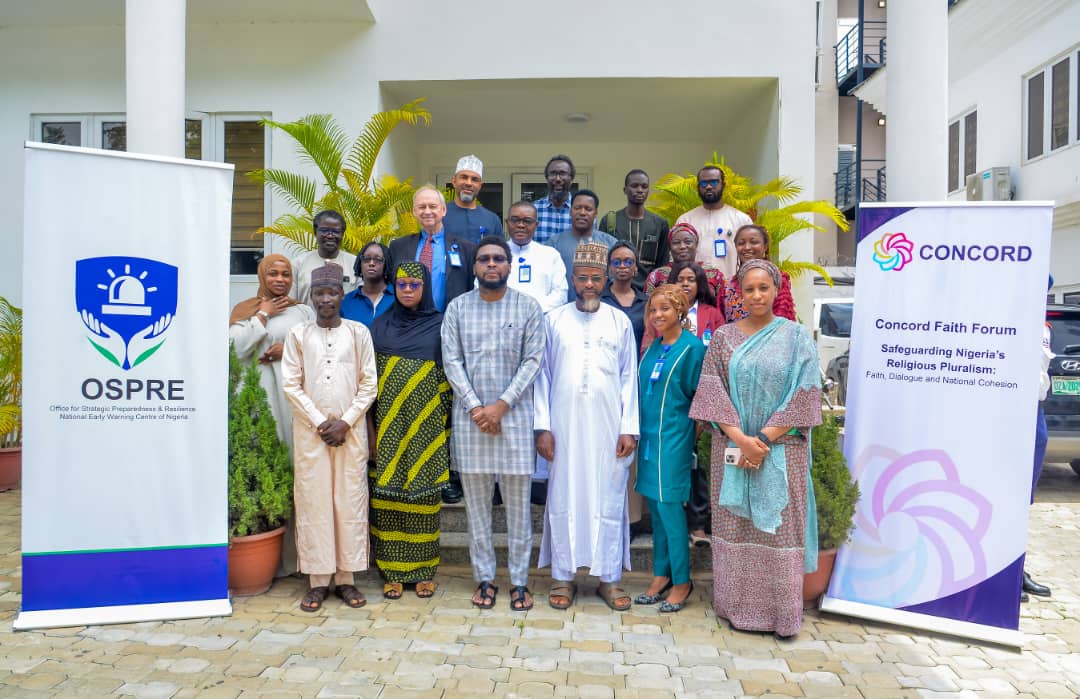
The Office for Strategic Preparedness and Resilience (OSPRE) and CONCORD, a non-profit organisation focused on peacebuilding, development and human security, 𝚑𝚊𝚟𝚎 convened a strategic interfaith roundtable themed “Safeguarding Nigeria’s Religious Pluralism: Faith, Dialogue and National Cohesion.”
The dialogue brought together faith leaders, peacebuilding practitioners, community organisers, policy actors, and civil society stakeholders to examine emerging local and global narratives surrounding religion and violence in Nigeria, while exploring collaborative pathways for strengthening social cohesion, peace, and national resilience.
This was conained in a press statement jointly signed on Friday by Hafsah Matazu Programme Manager, Office for Strategic Preparedness and Resilience (OSPRE)/National Early Warning
Centre, Abuja, Nigeria and Amina Wali Communications Manager, CONCORD.
Participants at the forum emphasised the importance of constructive engagement and collective action in addressing the complex drivers of insecurity and social fragmentation across the country.
Speaking at the event, the Director General of OSPRE, Mr. Chris Ngwodo, called for a concerted national effort to address the vulnerability of rural communities affected by violence and insecurity.
He stressed the importance of building broad-based solidarity in confronting the structural drivers of conflict and the interconnected challenges of justice, governance, and development under pinning insecurity in Nigeria.
According to him, sustainable peace and resilience require inclusive approaches that recognize the multidimensional nature of violence and prioritise the protection and empowerment of local communities.
Participants at the dialogue agreed that violence in Nigeria is complex and multidimensional, often involving overlapping strands of sectarian tensions, ethnic animosity, organised criminality, and resource-based conflicts.
They noted that responding effectively requires equally multidimensional strategies, including responsive local governance, improved protection for grassroots communities, and long-term investments in integrative initiatives that strengthen social cohesion and safeguard Nigeria’s pluralistic character.
Also speaking at the forum, Ms. Fatima Madaki, Director of Integrative Missions and Dialogue at CONCORD, highlighted the importance of nuanced and locally grounded engagement in the context of renewed international debate around religious freedom in Nigeria and the recent designation of Nigeria as a “Country of Particular Concern” by the United States Government.
“Nigeria’s strength has always rested in its diversity- our ability, despite challenges, to coexist, collaborate, and build shared communities across faiths and identities,” she said.
“At a time when misinformation spreads rapidly across social media and external narratives can easily deepen mistrust, faith leaders and civic actors have an even greater responsibility to promote calm, justice, empathy, truth, and national unity.”
Organisations represented at the dialogue included the Islamic Education Trust, the Catholic Secretariat of Nigeria, the Interfaith Dialogue Forum for Peace, the Centre for Civilians in Conflict (CIVIC), the Kukah Centre, Neem Foundation, the HumAngle Foundation, and the Centre for Peace Studies and Conflict Management, among other civil society and peacebuilding organisations.
The conveners reaffirmed their commitment to sustained interfaith dialogue, stronger civic partnerships, and collaborative peacebuilding efforts aimed at preserving Nigeria’s unity, strengthening resilience, and fostering inclusive national development.