BY JULIET EKWENUGO, Kaduna
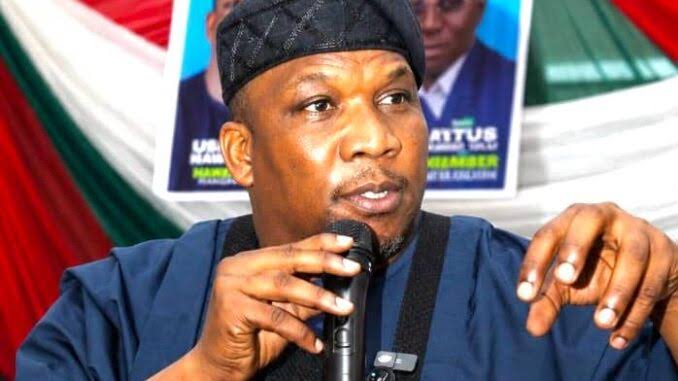
The Kaduna State governorship candidate of the Peoples Democratic Party (PDP), Usman Shehu Bawa, has raised the alarm over an alleged N1 trillion public debt in the state, pledging accountable and people-centred governance if elected in 2027.
Bawa warned that the debt burden, alongside poverty, poor learning outcomes and high healthcare costs, posed challenges to sustainable development in the state.
He spoke on Wednesday, October 28, 2026, during a one-on-one policy dialogue with governorship candidates in Kaduna State, organised by the Partnership for Issue-Based Campaign (PICaN).
“Currently, Kaduna State is in a debt trap. The total public debt of Kaduna State is N1 trillion,” he said.
The candidate cited figures showing that Kaduna’s external debt stood at $684.29 million, while its external debt-to-revenue ratio was 312.66 per cent, which he said exceeded the 150 per cent limit referenced in his presentation.
However, the figures presented by Bawa were not independently verified at the event.
He also compared the state’s debt profile under previous PDP administrations between 1999 and 2015 with that of successive All Progressives Congress (APC) administrations from 2015 onward.
Bawa put external debt at $226.37 million during the period he associated with PDP administrations and $684.29 million under APC administrations. He also cited domestic debt figures of N49.85 billion and N84.64 billion, respectively.
Against this backdrop, he pledged to adopt a bottom-up approach to governance, with communities directly involved in determining development priorities and monitoring public projects.
He said his proposed administration would consult stakeholders across Kaduna’s 255 wards to identify local needs and ensure that budgetary allocations reflected the priorities of residents.
“Our approach is a bottom-up approach, not a top-bottom approach,” he said.
Bawa explained that if his administration had a budget of N100 billion, stakeholders across the state’s three senatorial zones would be consulted to determine the most pressing needs of their communities.
“We want to build the bridges in the exact wards that need those bridges, not build boreholes where you do not need them or build classrooms where you do not need them,” he said.
He said the approach would help reduce wasteful expenditure and ensure that government projects addressed actual community needs.
The PDP candidate also promised a multi-level monitoring and evaluation system involving community, ward and local government committees to track projects and report implementation gaps.
According to him, the findings would be escalated through relevant local government and sectoral structures to the central monitoring and evaluation system.
“Once you take a project to the community, one of the best ways to be sure that the work has been done is by involving the local people there,” he said.
Bawa identified security, healthcare, education, infrastructure, economic empowerment and institutional accountability as priorities of his proposed administration.
He promised to improve access to healthcare and education, strengthen social protection and create opportunities for small and medium-sized enterprises to grow.
He also pledged equitable governance and a fair distribution of resources, saying the different religious and social groups in Kaduna State must have a sense of belonging.
On long-term planning, Bawa said sustainable development required a framework that would guide successive administrations beyond a single tenure.
“I was thinking of doing 20 years or more because if you have a plan for a state, you have to use long projections and see how you plan within and beyond the government,” he said.
He added that his proposed administration would align its policies with the PDP manifesto and prioritise human capital development, justice, peacebuilding, infrastructure, institutional reforms, technology, agriculture and environmental sustainability.
The candidate also recounted his experience in the mobile phone and accessories business, saying he built his operations through trade involving Nigeria and Dubai and markets in Kano, Kaduna and Abuja.
He urged aspiring entrepreneurs to identify opportunities, take calculated risks and remain focused on their goals.
“We don’t all have to be nine-to-five workers. There are different ways you can impact, and there are different ways you can grow,” he said.